Saturday, June 4, 2011
Monday, May 23, 2011
What's Going On?
Marvin!May 21st marked the 40th anniversary of the release of Marvin Gaye's What's Going On album. It's still ranked in the top ten of Rolling Stone's greatest albums of all time and I'm not sure a week has gone by in the better part of ten years when I haven't plugged into "Mercy Mercy Me", "What's Happening Brother" or "Inner City Blues"; the sound, the words and the feel are timeless.
I found myself skimming through an NPR piece commemorating the anniversary of the release this morning and I was inspired to pull my headphones on once again. I have literally listened to "Mercy Mercy Me" hundreds of times but the echo of the beat and that first "woooah" gave me the chills.
What's Going On has been my companion when I have been in love and when I have been heartbroken. It has moved me to think about how we live, how we consume and it has also moved me in the shadows of a late-night dance floor.
NPR's Felix Contreras said this about the album and "Mercy Mercy Me":
"Listen again to the words: Have things really changed that much? I hear references in 'Mercy Mercy Me' that could just as easily point to the oil spill in the Gulf and the recent nuclear crisis in Japan. It's hard to imagine any other song that still holds so many lessons for us, let alone in a mere three minutes and 12 seconds.
Marvin, you're forever.
Saturday, May 7, 2011
"He was a tall rich kid who thought God talked to him"
I'm an avid reader of Ta-Nehisi Coates' blog over at the Atlantic. He's their culture blogger and recently posted an interview the author Pete Hammill gave on Osama bin Laden's death.
I haven't read any of Hammill's stuff, but his novels are littered across book shelves in my parents house. As my Dad -- a former journalist from New York -- recently told me, "Hammill was one of those great, edgy New York reporters. I remember the buzz around town when he first started. He is a once in a generation talent."
I think one of his novels is in my very near future. If there is a better interview out there about bin Laden's death and the reaction in the U.S, I haven't seen it:
What was your response?
Nothing dramatic. I didn't jump for joy because after 50 years of being a newspaperman, I realize that if you think you know what it's all about at the moment, you're usually wrong. I was also hopeful that nobody would say, "This brings closure."
Don't you think that killing him will help Americans deal with the losses we suffered on 9/11?
If you lost a daughter or son or father or someone at the Trade Center, it will follow you to your grave. You're never going to get rid of it just because somebody shot this asshole in the head.
What did you think about the Daily News' headline, "Rot in Hell"?
I wasn't thrilled by it because bin Laden couldn't see those three words.
But didn't you agree with the sentiment?
It's easy to be a tough guy when no one's going to come knocking on your door. I thought of all those people--the ones who jumped out of windows, the firemen, people running down the jammed hallways trying to get out. I thought more of them--but I'm glad they got bin Laden. I have no sympathy whatsoever for him--he was a tall rich kid who thought God talked to him. He used money he'd never earned to kill people and called it a holy mission.
Monday, May 2, 2011
Hot Knockers
Most people come to Old Town for the architecture, antique shops or cafes but they often miss the small details that residents hold dear. For example, Old Town simply has great knockers...door knockers that is.
So begins the first installment of what will become a series on this blog: "hot knockers." Enjoy.
Thursday, April 21, 2011
The Office Punka Wallah
Spring in DC is a fickle season. One day it’s cold and rainy and the next it’s mid-summer hot. Today was of the sneaky hot variety and temperatures around town hovered in the mid-eighties. Coincidentally, my firm was hosting a large group in our conference room – a room notorious for its impossibly bad ventilation. This got a few of us talking about last-resort cooling systems, which reminded me of punka wallahs.
For those of you unfamiliar with punka wallahs, they were manual fan operators particularly popular in Raj India. The punka is a large, overhead, swinging fan and the wallah its power source.
It’s not so difficult to imagine Victorian British at dinner in their Bungalow, dressed to the nines, with a grumpy, mustachioed coolie sitting to the side, pulling the cord for their luxurious fan.
After losing myself in a Siege of Krishnapur fantasy, I returned to earth with this rather solid idea for the office. Let’s hire an intern and get them a pullin’. There is no reason they couldn’t answer the phones with one hand and power the conference room punka with the other – common sense if I say so myself.
So, if you’re looking for a summer internship with a Washington PR firm, or know someone who is, I have a “unique opportunity” for you.
Wednesday, April 20, 2011
A New Chapter
And back to Capitol Hill… I have little interest in changing the title of the blog but I returned to Washington two months ago. My time abroad already seems like a far-off moment tucked into a photo album. I have traded rickshaws for the DC metro and dumpling houses for Five Guys’ burgers.
If Washington was my far off, exotic adventure, and not home, what a destination it would be. The city is simply magnificent. Spring has come, with it Cherry Blossoms and a burst of activity on the Mall. L’Enfant’s elegant avenues are infested with tourists but this year I don’t seem to mind the plague.
To watch a 10 year old boy look onto the Capitol or the Lincoln Memorial for the first time will get you if you’re not careful. I suppose a little flag waving isn’t such a bad thing.
So, I’m going to begin writing again. I’m going to give Washington the same attention I gave Bangalore, Hong Kong or Taipei.
It’s good to be back.
Friday, January 21, 2011
The cause of the Civil War
Somehow, someway Americans still debate the cause of our Civil War, or ,more precisely, why the South seceded. I'm shocked every time I engage in this debate that the cause is debatable at all. With 2011 the 150th anniversary of the beginning of the war, I think it's a worthwhile investment for folks to brush up on their history. Not everyone is expected to pick up Shelby Foote, James McPherson or Michael Sahara but there are "cliff notes" available on the war that I think are worth a read. The Washington Post has produced some great content as it covers this momentous anniversary. For example, the Post is tweeting the war, producing short historical quizzes and offering smart briefs such as, "Five myths about why the South seceded."
So if you do have any lingering questions about why the South seceded look no further. From the Post:
"On Dec. 24, 1860, delegates at South Carolina's secession convention adopted a 'Declaration of the Immediate Causes Which Induce and Justify the Secession of South Carolina from the Federal Union.' It noted 'an increasing hostility on the part of the non-slaveholding States to the institution of slavery' and protested that Northern states had failed to 'fulfill their constitutional obligations' by interfering with the return of fugitive slaves to bondage. Slavery, not states' rights, birthed the Civil War.
"South Carolina was further upset that New York no longer allowed 'slavery transit.' In the past, if Charleston gentry wanted to spend August in the Hamptons, they could bring their cook along. No longer -- and South Carolina's delegates were outraged. In addition, they objected that New England states let black men vote and tolerated abolitionist societies. According to South Carolina, states should not have the right to let their citizens assemble and speak freely when what they said threatened slavery.
"Other seceding states echoed South Carolina. 'Our position is thoroughly identified with the institution of slavery -- the greatest material interest of the world,' proclaimed Mississippi in its own secession declaration, passed Jan. 9, 1861. 'Its labor supplies the product which constitutes by far the largest and most important portions of the commerce of the earth. . . . A blow at slavery is a blow at commerce and civilization.'"
Thursday, January 20, 2011
Poland or Virginia?
This post is a quick break from the normal routine but I think you will find it interesting. The Economist has produced a new interactive map that compares the GDPs and populations of U.S. states to countries around the world. This might sound a little geeky but it's a hell of a lot of fun to play with.
So a few quick stats. California has the world's 8th largest economy, just behind Italy's but a notch above Brazil's. Virginia's economy is about the same as Poland, West Virginia is neck and neck with Iraq and Mississippi is running tight with Bangladesh -- that sounds about right.
Anyway, I highly recommend a visit. You just might be surprised with what you find.
Check it out here.
Wednesday, January 19, 2011
Swing and a miss
Everybody likes buzz words. You certainly don't need to be a marketing or advertising pro to use them. However, familiarity with the language you hope to employ them in can be useful. I give you Taiwanese branding gone awry -- part 1.

There are so many signs like this throughout the city I rarely go a block without laughing. The misspelled or confused English language sign in Taiwan is the tribal or Asian character tattoo in the states. Just priceless.
Tuesday, January 18, 2011
Welcome home and good morning
For the next month I'm calling apartment 280 on the fourth floor home. What the address of the building is, I have no idea. The hallway outside the door smells exactly like the Daoist and Taoist temples I have visited here. I sometimes leave the door cracked to let that spicy incense smell waft in and overtake the place. I always hope foreign locals have uniquely exotic smells. So far, I haven't been disappointed.
The door to the apartment has some kind of blessing taped onto it to keep evil spirits away. I rather like the Chinese characters even though I have no idea what they mean. But alas, a lot of things are fuzzy here. While I spend 90% of my day confused the Taiwanese are little confused themselves.
No one here speaks fluent English. If you're lucky you might find someone who can sputter out a few phrases but that hasn't stopped the Taiwanese from integrating some English into the their lexicon. Not surprisingly, this has gone terribly wrong.
No matter the time of day, you are greeted by "good morning." Apparently, everyone thinks it means "hello." Walk into a convenience store at 4:30 pm and it's a bow and "good morning." Walk into a bar at 10:30 pm and the bartender is sure to offer a "good morning." I have to bite my tongue every time. You can't help but want to laugh; but attempted cultural immersion means going with the flow. Taking Jessie's lead, I have learned to sling it right back. So no matter what time it is for you, a very good morning.
The door to the apartment has some kind of blessing taped onto it to keep evil spirits away. I rather like the Chinese characters even though I have no idea what they mean. But alas, a lot of things are fuzzy here. While I spend 90% of my day confused the Taiwanese are little confused themselves.
No matter the time of day, you are greeted by "good morning." Apparently, everyone thinks it means "hello." Walk into a convenience store at 4:30 pm and it's a bow and "good morning." Walk into a bar at 10:30 pm and the bartender is sure to offer a "good morning." I have to bite my tongue every time. You can't help but want to laugh; but attempted cultural immersion means going with the flow. Taking Jessie's lead, I have learned to sling it right back. So no matter what time it is for you, a very good morning.
Friday, January 14, 2011
Rainy Days in Taipei
After a couple of fantastic weeks at home in Alexandria I headed west to get east. I have been in Taiwan for six days now and I have to tell you I'm pleasantly surprised. I'm not sure what I was expecting but I'm really enjoying my time here. The people are interesting and awfully friendly, the food is damn good and what I have seen of Taipei city is rather impressive.
I'd say the only negative of my stay so far has been the weather. It has rained five and a half of the six days I have been here. I have seen the sun for maybe 20 minutes. While the rain hasn't really slowed me down it has given me reason to pause.
It rarely rains hard, usually not much more than a mist, and for my first few days I left the umbrella behind and marched down the street with nothing more than a waterproof jacket with no hood. I'm of the attitude that a little water on your face never hurt you, but apparently, I was mistaken.
As I found out, the rain here is acid rain, full of all kinds of undesirables from China's coal plants and industry. While Taiwan is hyper-environmentally conscious and clean,(I have never seen a country take recycling so seriously) there is little to be done about the pollution that rolls in from the mainland. No one here ventures out without a hood, hat or umbrella. Apparently, it's not uncommon for people's hair to fall out from overexposure to the rain. Needless to say, I don't go anywhere without my umbrella.
While I have yet to breath in the air in Beijing or stare down at one of China's nameless and massive industrial cities, this was the first time China's (our) environmental nightmare became real to me.
By chance, I noticed a review in Slate magazine of Jonathan Watts' When a Billion Chinese Jump. The book is a new and nuanced look at the eco-disaster brewing in the PRC. The review is gripping and the book seems fascinating.
"When Jonathan Watts was a child, he was warned: 'If everyone in China jumps at exactly the same time, it will shake the earth off its axis and kill us all.' Three decades later, he stood in the gray sickly smog of Beijing, wheezing and hacking uncontrollably after a short run, and thought: The Chinese jump has begun. He had traveled 100,000 miles crisscrossing China, from Tibet to the deserts of Inner Mongolia, and everywhere he went, he discovered that the Chinese state had embarked on a massive program of ecological destruction. It has turned whole rivers poisonous to the touch, rendered entire areas cancer-ridden, transformed a fertile area almost twice the size of Britain into desert—and perhaps even triggered the worst earthquake in living memory."
I'm off to find a copy.
Tuesday, December 28, 2010
We Three Kings
It's been a few days since I have posted so to kick things off again I thought I would touch on the original Christmas story -- baby Jesus, the manger and of course the three kings.
A few days before my trip home I finished a fantastic book, titled In Xanadu, by the British author William Dalrymple. Dalrymple has written a number of incredible books on India but In Xanadu was his first literary effort. It's a travel story about his attempt to retrace Marco Polo's journey from Jerusalem all the way to Xanadu, Kubla Khan's palace in Mongolia. He successfully made the trip during the summer before his final year at Cambridge and published the book at 22. It's fantastic and I highly recommend it but enough background.
In one stretch of his journey through modern day Iran, Dalrymple finds his way to a city that according to Marco Polo once hosted the bodies of the three kings or wise men who came to Jesus in Bethlehem. These wise men, or Magi, made the famous offering of gold, frankincense and myrrh and in the course of their pilgrimage founded the fire-worshiping religion of Zoroastrianism in Persia.
This is where I found myself intrigued. The following are a few passages from Dalrymple. Despite references to several almost forgotten historians hopefully you will be able to follow. Apparently, Marco Polo may have actually been onto something.
"At first sight the legend looks interesting, but wholly mythical...But one or two of the details in the story made me think twice about dismissing it in its entirety. According to Yule, the word 'Magi' used by St. Matthew in his gospel does not actually mean wise men, as I had always assumed. The word is Persian, and so stands out in the Greek of the Gospel as a solitary foreign word. Its meaning is specific. It is the name of the ancient Zoroastrian priestly class. In all the elaboration that has grown up around the story in the Gospel, St Matthew's original meaning has been obscured. In the text the men who follow the star from the east are not the kings. Nor are they numbered or given names: this is all mediaeval legend. The Gospel text simply reads 'Some Magi came to Bethlehem from the East.' St Matthew's original audience would have understood that this meant a visit to Bethlehem of fire-worshiping priests from Persia."
He continues, "As I read Yule's footnotes I remembered depictions of the Magi that I had seen on sarcophagi in the Vatican Museum and in the mosaics of St Apollinare in Nuovo in Ravenna. The Magi are shown wearing trousers, tunics and pointed felt caps--the distinctive dress of the ancient Persians. This in turn reminded me of a story I had read the previous year in Runciman's The First Crusade. In the seventh century, the Persians had defeated the Byzantines and had swept through Palestine burning and pillaging every important building they had come across. Only one structure was spared: the Church of the Nativity in Bethlehem. According to Runciman, they made this single exception because over the doorway of the church was placed a huge mosaic showing the three Magi worshiping the Christ child. If the specifically Persian origin of the Magi is perhaps obscured today it was clearly understood into the early Middle Ages."
I suppose make of this forgotten piece of history what you will but I found it particularly interesting. Dalrymple is not finished here but I thought I would save the second part of this story for another day.
Monday, December 20, 2010
Old Delhi and Chandni Chowk
For obvious reasons, medieval cities or neighborhoods are hard to find these days. I have wandered through a few, notably the Trastevere neighborhood in Rome, the cities of Sienna and Venice and most recently Old Delhi. These places are defined by impossibly narrow streets and almost non-existent city planning. For the most part, maps are worthless.
While I only had a few hours to get lost in Old Delhi, I was left with a lasting impression. Never had I been to a place with so many people in such tight quarters. When just a block or two away from the main commercial arteries, the architecture is fascinating – looming three and four story havelis with incredibly elaborate entrances that open to magnificent courtyards. I was in India but at moments it seemed I had been transported to a more colorful, Eastern set for Romeo and Juliet.
But as interesting as the buildings and monuments are in India the people always steal the show. Outside of the canopied jungle of medieval streets and alleyways I decided to shoot a quick video of the scene on Chandni Chowk – the 500 year old “main street” of the Mughal city. If you look closely at the end you can see the famous Red Fort in the distance – the ultimate symbol of Mughal power. Enjoy:
Friday, December 17, 2010
Back to the States and Prince (again)
I'm cold, really, really cold. I think the transition from 80 degrees and the Indian sun to 25 and snow in Washington would be tough on anyone. Pulling my bags out of the car in topsiders and no socks last night was inadvisable.
But anyway, I'm home for Christmas for a few weeks and while I'm going to continue to write about India while I'm here (there is more than enough in the vault) I'm also going to sprinkle in a few other topics as well.
When I woke up at five this morning I browsed a few of my favorite blogs and came across an interesting post from the Atlantic's Ta-Nehisi Coates on sexuality and Prince. He writes about sitting down with his son and telling him how to talk with women and that Prince will absorb a significant part of that conversation.
He goes onto to write, "Watching Prince as a kid, we derided him as gay and had no sense as to why all the young girls were into him. But looking at him now, though it much it aggrieves me, it must be said that Prince is, indeed, a sexy motherfucker.
Homophobia doesn't just make you bigot, it ruins your music taste and makes it harder to understand women--perhaps not in that order."
I couldn't agree more. I think back to watching Prince on MTV in the early 90s. The video that sticks out to me is "Diamonds and Pearls" and I remember being utterly confused by him but transfixed by the sound. I'm not saying your homophobic if you don't like or appreciate Prince but give him another listen if you passed him off because of the androgynous look.
For a fantastic video of him performing "If I was your girlfriend" go here.
Wednesday, December 15, 2010
Sepoys and Squares
I stumbled onto a fantastic website dedicated to the Mysore Wars and came across a Scottish manuscript describing the training and regulations for a company of native infantry (commonly called sepoys) in the service of the East-India Company. I haven’t read too many military manuals but I think you would be hard pressed to find one so colorful.
“If a Battn. (Battalion) is attacked by a large Body of Horse on a plain, it is to form the Square or Oblong, half and face outwards. Should the Horse appear within the distance of 300 Yds the Bttn with a well directed fire of Grape or Case shot will in all probability keep them at bay; if however from superior numbers and the intoxication of Bang they should approach within the distance of 100 yds, the front rank will make ready. If the Cavalry should still persist in advancing to the distance of 60 yds, the front rank will present and the rear rank make ready. It is of the first importance that men should preserve their fire on this occasion. If the Cavalry should however persist in advancing to the distance of 50 yds the front rank will fire.” When the cavalry approaches within 20 yards the square is to remain “steady and fully determined to defend themselves like Gallant soldiers to the last extremity.”
The language is rich and inspired. For example, the author describes the smoke produced from musket and cannon fire as “intoxication of bang.” And the last sentence reads like a Hollywood script: “…defend themselves like Gallant soldiers to the last extremity.”
For all of the destruction and terror of war, the scene described above has a certain beauty to it. Splendid, Indian lancers rushing across a plain, foam coming from their horses’ mouths, the gold and silk of their uniforms gleaming in the sun as they close in on the red lines of soldiers in front of them. The ranks of British infantry stone faced, squinting through the smoke of the field, holding their fire as the cavalry comes like a wave. Sepoys and highlanders shoulder to shoulder, bayonets fixed, waiting for their officers' commands.
Sunday, December 12, 2010
Four Days in Delhi: Part 2
The tour bus is a time portal to 1978. There is an abundance of fake wood paneling, synthetic carpeting and knobs and buttons that don’t work. Despite my instincts, I refrain from making a judgment about the coming tour based on the vehicle. I have my fingers crossed the guide will be a magical repository of knowledge about the seven cities of Delhi. I’m imagining him as an old, gray-haired Indian storyteller who has traded an audience of hookah-smoking locals for busses of tourists. With the first crack of the intercom my hopes are dashed.
The noise directed at the 20 of us on the bus is technically English but even that description might be kind. I turn my attention away from a guy peeing on the wall just outside the bus to get a good look at our guide. He is middle aged, short, a little plump and seems genuinely irritated he has to narrate our tour. He is wearing a plaid fedora, a bushy mustache, a Cosby sweater, gray slacks and white tennis shoes. His English is suspect but the ancient intercom system makes everything he says almost completely unintelligible. He is well aware no one can hear or understand what he is saying but he simply doesn’t give a damn.
What I’m able to pick out from his mumbling and from the schedule of the tour is that the morning will be spent in New Delhi and the afternoon is reserved for the old city. At first I’m slightly amused by the guide but after ten minutes of driving I find myself disgusted with the prospects for the day. As we head to our first stop, a large but relatively new temple blessed by Gandhi, we drive down an impressive avenue lined with embassies. The narration from the front of the bus is as follows: “US embassy,” pause, “Canadian embassy,” pause, “Malaysian embassy,” pause, “Chinese embassy,” longer pause, “Pakistan embassy,” followed by a guttural throat clearing noise and silence. I turn to Chetan, who is sitting to my right across the aisle, and with a sorrowful headshake say, “riveting stuff.”
The first stop at a completely forgettable temple flies past. I take a few pictures, dodge postcard sellers and return to the bus. As I wait for the rest of the group to return, I notice several motorists weave through traffic, pull over as they come upon the temple, say a few prayers and keep moving. It’s a wonderfully Indian scene.
Back on our motor chariot we head for the Qutub Minar, a nearly 240 foot brick and sandstone minaret built by an Afghan conqueror at the end of the 12th century. The tower was erected as a victory monument in the midst of the ruins of a destroyed Hindu temple complex. It is massive, beautiful and awe inspiring.
Our guide gives us 30 minutes to explore the tower and ruins littered around its base. A comically short amount of time for the site but I duck in and out of crumbling mosques, through Indo-Saracen arches and around intricately carved pillars, repurposed from the Hindu temples once the heart of a destroyed city. The 30 minutes fly by. Back on the bus we head for an unannounced stop.
After 20 minutes of battling rush-hour traffic we pull into a gravel parking lot of a handicrafts emporium. Our disgruntled guide announces we have 45 minutes to shop. I immediately pull out my map of Delhi, pick out a few sites I’m dying to see, announce to Chetan we are leaving the tour and begin my hunt for a rickshaw. As we leave the tour behind, I grab one last glimpse of our guide. He is sitting on a broken down chair outside the Emporium, staring at nothing, irritated as ever.
Saturday, December 11, 2010
Four Days in Delhi: Part 1

We are already running late. Our Gurkha driver, Seeray, flies down the highway in our Ford into the center of the city, his face almost completely covered by a winding scarf. It’s winter in Delhi and barely 50 degrees. The car windshield is completely fogged up but we shoot forward, split two rickshaws and scream into the parking lot of the city Tourist Department which also happens to double as the city’s sprawling flower market.
Seeray, a sergeant in the 10th Ghurka Rifles and personal attendant to a Brigadier General, throws the car into park and beckons us forward into the maze of flower peddlers. He is thick and noticeably athletic. While immensely kind to us he is precisely the type of soldier no man wants to meet in the field. He is under strict orders to get us to the tourist office by 7:45 am sharp to ensure we are on time for our 8:00 am bus tour. Failure is not an option.
He moves exceptionally fast through the single-file paths of the market, jumping over flowers, dodging lazy buyers sipping chai and reversing direction when need be to reroute around human roadblocks. He is in front, followed by my impossibly close friend Chetan, – the nephew of the Brigadier General – me and then Chetan’s girlfriend Rosie.
When cutting through the pushy tangle of the flower market proves impossible, Seeray leads us out to the edge of the road in an attempt to circumvent the mess and get us to our destination. As we move down the street, motor bikes and rickshaws fly past inches to our left. I keep edging further out into the street trying to use my body as a shield for Rosie as we push forward. My plan doesn’t work. A motorbike flies past me and a side-view mirror clips her shoulder. She grunts, assures me she’s okay and we keep moving.
Friday, December 10, 2010
Delhi
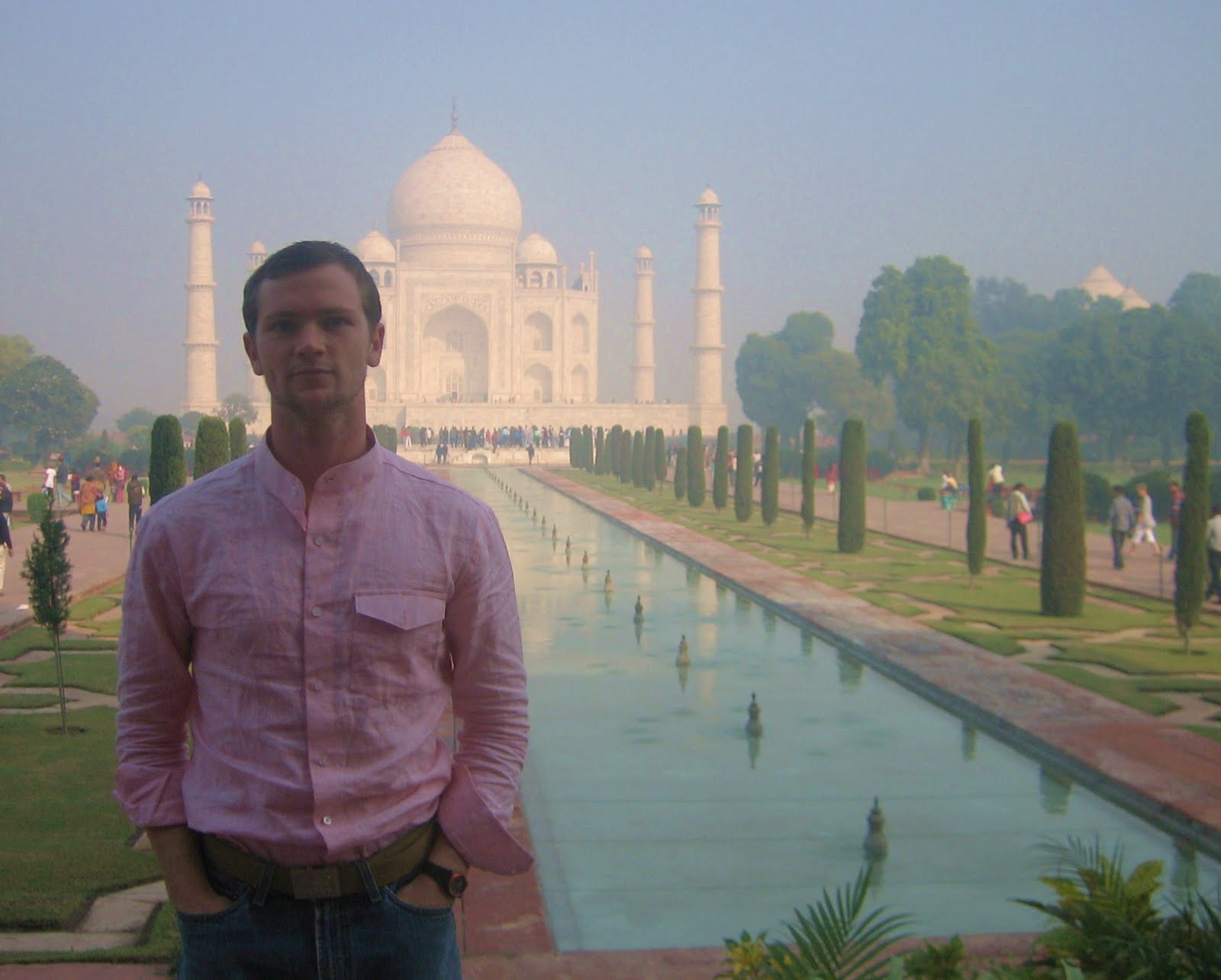
India is not for the casual tourist. I have heard it called the most difficult place in the world to travel and my experiences have yet to suggest otherwise. But for its challenges I can't imagine any place more rewarding.
Four days in Delhi overwhelmed the senses. There are too many places, anecdotes and pieces of history to put into one or ten posts but an introduction to it all.
Christmas came early this year.


Four days in Delhi overwhelmed the senses. There are too many places, anecdotes and pieces of history to put into one or ten posts but an introduction to it all.
Christmas came early this year.
Sunday, December 5, 2010
The Tiger of Mysore

When things didn’t work out particularly well for the British in the American War for Independence they turned their attention elsewhere, most notably India. By the 1780s they had extended control over significant portions of the subcontinent but their future subjugation of the country was still very much in doubt.
India was locked in an almost constant state of war between rival states and their European allies – such as the Mughals in the north, The Marathas in the west, the Nizam of Hyderabad in the Deccan and Tipu Sultan of Mysore in the south.
Tipu Sultan was a thorn in Britain’s side. He was young, ambitious, aligned with France and possessed a European trained and equipped army that had already beaten the British in two wars during the 1760s and 80s. The British called him the Tiger of Mysore.
Future British expansion in India meant inevitable conflict with Tipu. Sighting his close ties with France, the British East-India Company convinced parliament to launch a decisive campaign against Mysore in 1789. The final push against Tipu would result in two wars – both resulting in British victories – but the conflicts were hotly contested and featured an incredible cast of characters. Lord Cornwallis, the general that surrendered to Washington at Yorktown, and the future Duke of Wellington, who would later defeat Napoleon at Waterloo, both commanded on the British side.
Since my first visit to India in 2008 and a trip to the Tiger of Mysore’s island fortress, Seringapatam, I have been fascinated with this relatively forgotten moment in history. War elephants, Scottish highlanders rushing over Indian fortress walls, and a sultan called Tiger – this struggle had it all.
Friday, December 3, 2010
Village Market
Last weekend I spent two amazing days at a coconut farm five hours outside of Bangalore. There were trips to temples (a post is on its way), beers around the campfire and the village India I had only read about in books.
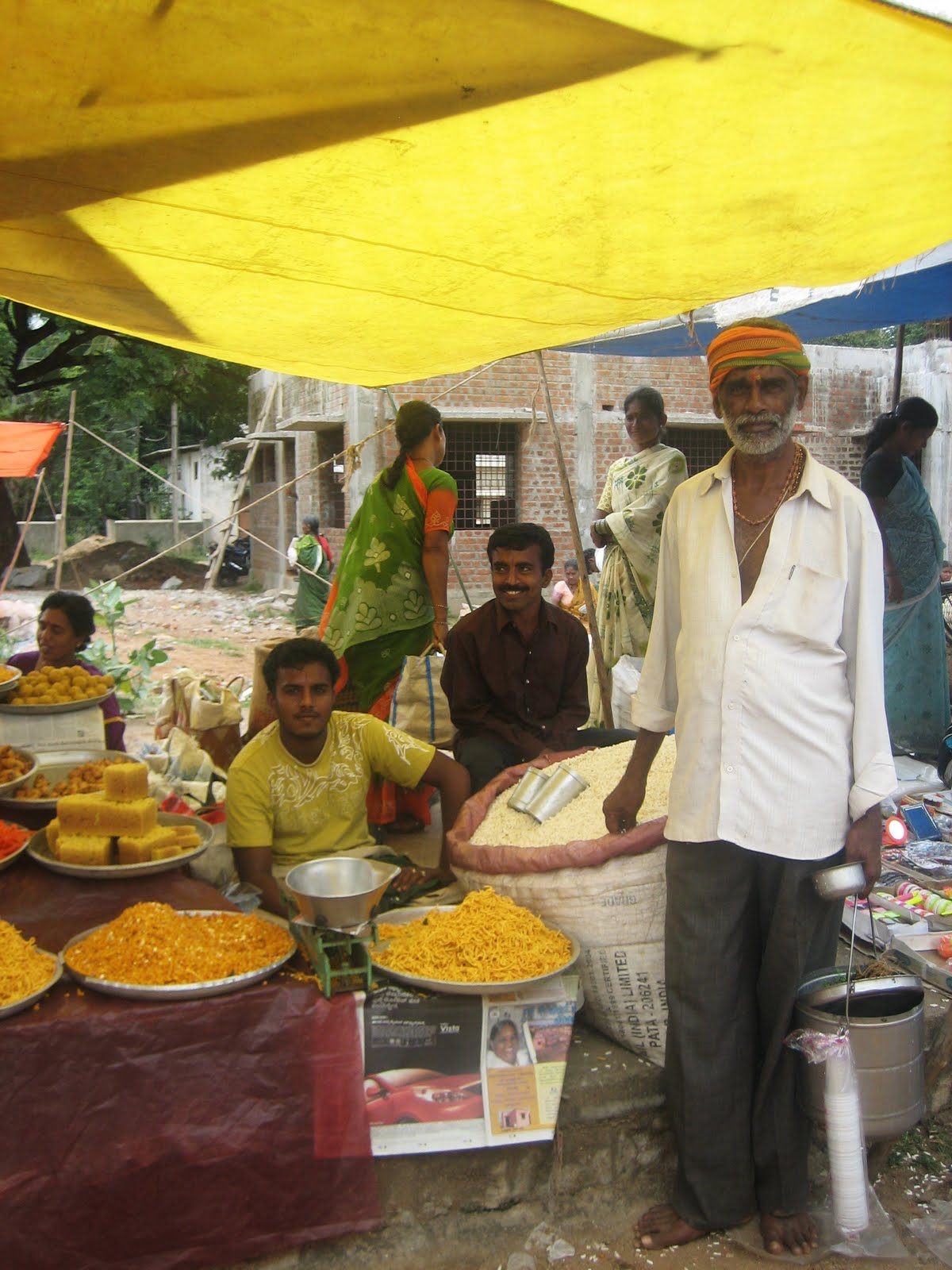
The countryside, the farm and the villages were beautiful. But, just when I thought the weekend had come to an end, there was one last stop at a local market to top it off.
I couldn’t help but pull out my camera and begin snapping away. I have found that a smile and a thumbs up are a common language not to be underestimated. For a half hour I moved through onion, lentil, ginger, banana and spice tents. I dipped around fashion stands, candy stalls and rope vendors.
After each photo I would spin the camera around and let my subjects see their portraits. I patted backs and laughed with the locals. It was the kind of morning I won’t soon forget.
Subscribe to:
Posts (Atom)